
On this page · 12 sections
- 01AI made producing work cheap
- 02Your AI generated the report. Did anyone read it?
- 03The bottleneck moved
- 04AI slop is bigger than bad images
- 05More output can create more work
- 06The Philippine version of this problem
- 07Good automation decides what needs attention
- 08Ask a different question about AI
- 09AI throughput isn't business throughput
- 10This is where Scale XY focuses
- 11Measure the outcome, not the output
- 12The next AI bottleneck is judgment
When people hear AI slop, they usually picture the same things.
An uncanny AI image on Facebook. A fake celebrity video. A post that sounds like it was written by the same chatbot as everyone else's.
Those examples are easy to spot.
The business problem is harder to see.
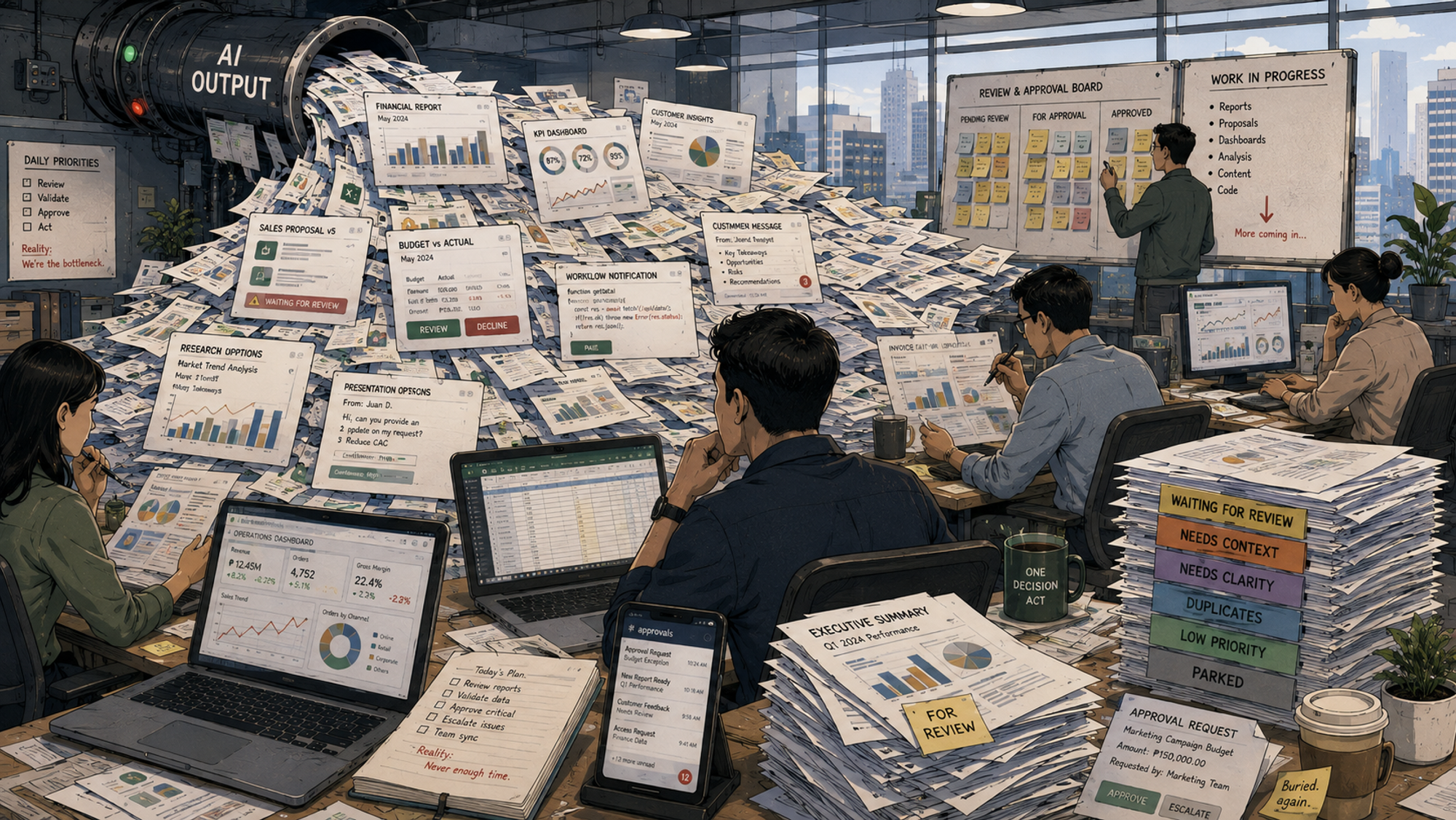
AI can now produce work faster than organizations can evaluate, contextualize, approve, and act on it.
That changes the bottleneck.
AI made producing work cheap
Think about the work your team produces every week.
Reports. Proposals. Presentations. Designs. Customer replies. Analysis. Documentation. Code.
A few years ago, much of that work took hours or days.
Now an AI tool can produce a first draft in minutes.
Your analyst can generate a report before the coffee gets cold.
Your designer can explore twenty concepts instead of three.
Your developer can generate a working version of a feature before lunch.
Your marketing team can turn one idea into weeks of content.
That sounds like a win.
But then someone has to deal with the output.
Your AI generated the report. Did anyone read it?
Say your operations team used to produce 10 reports every month.
Each report took several hours to prepare.
You introduce AI.
Now the team can produce 100.
Great.
Now ask:
Did anyone read all 100?
Did someone check the numbers?
Did someone verify the source data?
Did anyone notice the unusual result?
Which reports actually mattered?
Which ones required a decision?
Did anyone change what they were doing because of them?
If the answer is no, the business didn't get 10 times more productive.
It produced 10 times more reports.
Those are different outcomes.
The bottleneck moved
AI has made production much faster.
The work after production still needs people.
Someone needs to check whether the output is accurate.
Someone needs to understand the business context.
Someone needs to decide whether the result matters.
Someone may need to approve it.
Someone needs to act on it.
That creates a new constraint:
Your team may be able to produce more work than it can meaningfully process.
This applies far beyond reports.
Your AI can write 50 articles.
Who decides which five deserve to exist?
Your AI can generate thousands of lines of code.
Who reviews the changes and decides what belongs in production?
Your AI can summarize 500 customer conversations.
Who turns those summaries into changes to the product or customer experience?
Your AI can generate 30 presentation designs.
Who knows which one actually communicates the right message?
The system can produce the work.
The organization still has to make use of it.
AI slop is bigger than bad images
This is where the conversation around AI slop often misses the business problem.
People see a terrible AI-generated image and call it slop.
Fair enough.
But a company can create its own version of AI slop without generating a single image.
A 40-page report nobody reads.
A dashboard nobody checks.
An analysis that never changes a decision.
Code that saves an hour of writing but creates ten hours of review.
A customer response that answers the question but ignores the customer's situation.
A presentation built from numbers nobody verified.
The common thread is simple:
The business produced something without having a clear reason to use it.
More output can create more work
This is the part leaders should watch.
Imagine AI makes your team five times faster at producing reports.
Your team now has five times as many reports.
If management still expects someone to review every report, you haven't removed the bottleneck.
You've increased the review workload.
The same thing can happen with code, content, designs, research, customer communications, and analysis.
AI removes work from one part of the process.
The work doesn't necessarily disappear.
It can move to the next person.
And if you don't redesign the workflow, that person becomes the new bottleneck.
The Philippine version of this problem
This matters in Philippine businesses because many operations already rely on people to absorb volume.
More transactions? Add staff.
More documents? Add a processor.
More reports? Add a reviewer.
More customer messages? Add someone to the queue.
More reconciliation? Give another person the spreadsheet.
That approach has worked because people are flexible. They can catch mistakes, handle exceptions, and figure things out when the process doesn't quite fit.
But AI changes the economics of production.
If one person can suddenly produce five or ten times more work, adding people to review every piece of output doesn't scale.
You need a different workflow.
Good automation decides what needs attention
Consider a simple operational process.
A transaction comes in.
The system checks it.
If everything matches the expected pattern, it moves forward.
If the system finds a known exception, it routes the case to the right person.
If the system isn't confident, it asks for review.
If the decision carries significant risk, a person approves it.
And if the output has no practical use, the system doesn't create it.
That last part matters.
Sometimes the best automation is preventing unnecessary work from entering the workflow.
Ask a different question about AI
A few years ago, the natural question was:
Can AI do this?
Now you can answer "yes" to a surprising number of tasks.
A better set of questions is:
Should AI do this?
What happens after it does?
Who needs to review the result?
What happens when the system isn't sure?
Does anyone act on the output?
How will we know when the system gets something wrong?
Those questions determine whether AI improves an operation or simply produces more work.
AI throughput isn't business throughput
There is an important difference between the two.
AI throughput measures how much the system can produce.
Business throughput measures how much useful work the organization can process and turn into decisions or action.
A company that generates 10,000 reports isn't necessarily more productive than one that generates 1,000.
A development team that produces more code isn't necessarily shipping faster.
A marketing team that publishes more content isn't necessarily creating more demand.
A finance team that produces more analysis isn't necessarily making better decisions.
The output only creates value when someone can use it.
This is where Scale XY focuses
At Scale XY, we don't start by asking where we can insert an AI model.
We start with the workflow.
What happens today?
Where does the work enter?
Who touches it?
Where do people copy information between systems?
Where do approvals happen?
Where do errors happen?
Which cases follow the normal path?
Which ones require judgment?
And what happens after the work gets completed?
From there, we design the system around the operation.
Some work should run automatically.
Some work should use AI with human review.
Some cases should go straight to a person.
Some work should disappear altogether.
The goal isn't to make your business produce more things.
It's to make the operation handle more useful work with the same people, systems, and attention.
Measure the outcome, not the output
AI makes impressive demos easy.
"Look, it generated 100 reports."
That's not the metric that matters.
Ask what changed.
Did the team spend less time preparing reports?
Did people make decisions faster?
Did errors decrease?
Did someone actually use the information?
Did exception handling improve?
Did cycle time fall?
Did the team handle more transactions without adding headcount?
Those answers tell you whether the automation improved the operation.
A system that generates 100 reports instead of 10 may look impressive.
If your team now spends twice as long reviewing reports, it solved the wrong problem.
The next AI bottleneck is judgment
AI will keep getting better at producing things.
Reports.
Code.
Designs.
Analysis.
Research.
Documents.
Content.
The cost of producing each one will continue to fall.
That means production itself will become less interesting.
The harder problem will be deciding:
What should we produce?
What needs to be checked?
What requires human judgment?
What should trigger an action?
What should never enter the workflow?
That is an operations problem.
And it is where AI becomes much more valuable than a tool that simply generates things.
The businesses that get the most from AI won't necessarily be the ones producing the most.
They'll be the ones that build reliable systems around it.
AI should reduce the work your team has to manage, not create another queue for them.
That's the difference between using AI to generate more and using AI to run a better operation.
Scale XY embeds AI into real business workflows, connecting the systems, automating repeatable work, routing exceptions, and keeping people involved where judgment matters.
Book a free discovery call today:
Next articleWhy Some 5-Person Teams Are Outperforming Companies 10x Their SizeGrowth